
New enterprise module gives asset managers, investors and lenders quantified numbers on stranding risks, physical hazards, insurability and retrofit funding, from pre-screening through exit.
Holmdel, NJ, October 29, 2026. ESG Playbook, an AI-enabled sustainability and risk management platform, today announced its real estate dashboard, now available on the ESG Playbook Enterprise Platform.
The dashboard informs asset managers, investors, and lenders to identify the “true cost” of owning a building rather than rely solely on the asking price. Unlike general-purpose AI tools, every financial figure comes from deterministic formulas and links to its source, so rerunning a deal gives the same answer, and each number can be traced in review.
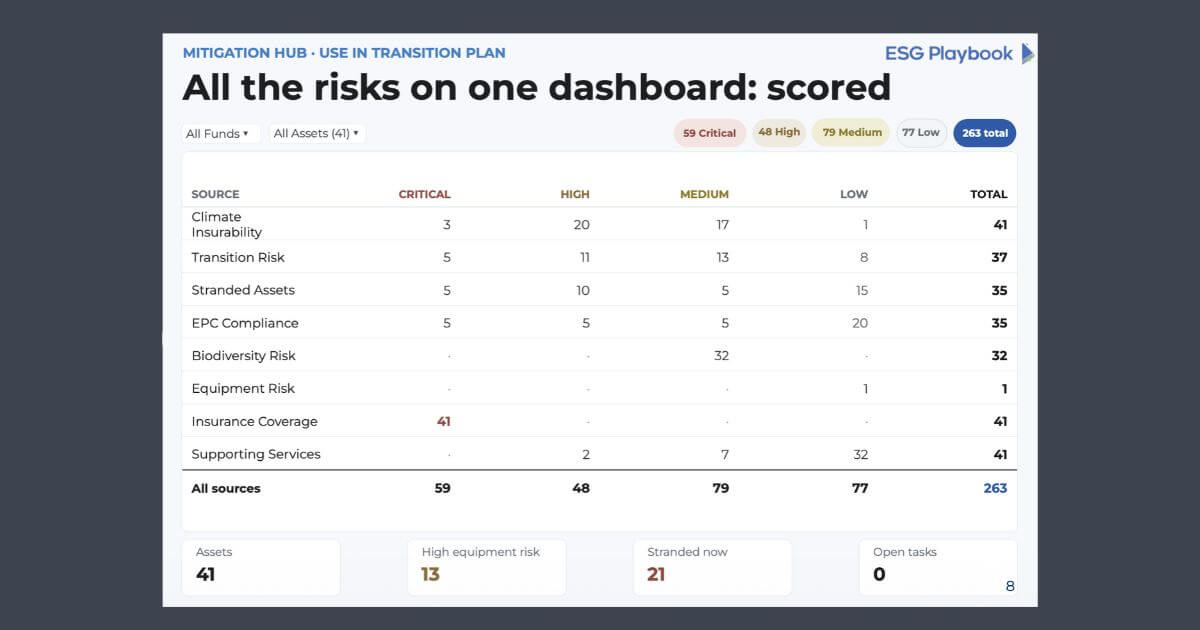
Deal teams can screen large pipelines in minutes, see what a building capex will require beyond its asking price, and match that retrofit plan over 1,400 incentive programs across 52 countries.
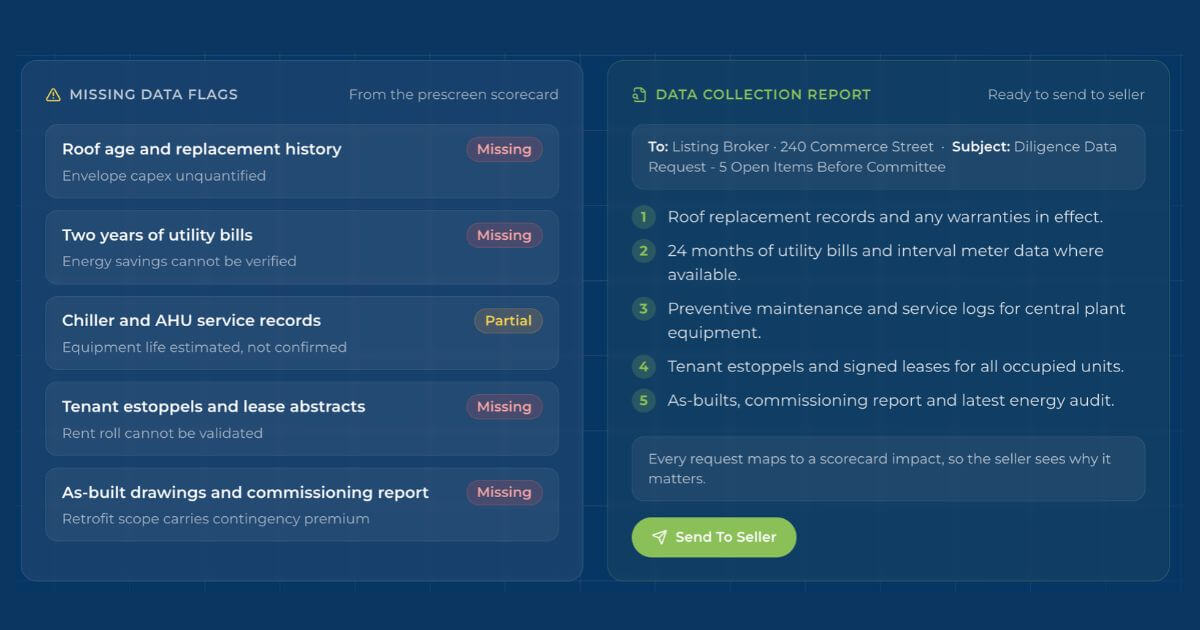
ESG Playbook also offers a managed pre-screening service for deal teams that want the insights without conducting the analysis themselves.
Clients can submit an Offering Memorandum (OM), and ESG Playbook will run the pre-screening and return a Deal Score with an assessment of the property’s risks and opportunities.
The service helps investors, asset managers and lenders identify potential concerns earlier and prioritize which properties warrant further due diligence.
Closing the gap between asking price and true value
Retrofit costs, stranding timelines and climate exposure are rarely fully quantified at acquisition. They tend to appear later, as required refurbishments, higher insurance premiums, lender refinancing reviews or impairments.
The dashboard brings them into underwriting before a deal closes, across six stages: pre-screening, purchase, energy efficiency upgrades, incentive funding, ongoing monitoring and exit. Key features include:
- Deal Desk pre-screening. AI-assisted screening of high volumes of opportunities. Each produces an eight-section report covering overall risk, strengths, red flags, data gaps, climate risk adjustments, NOI trajectory, tenant and rent roll sensitivity, and comparable transactions. Each OM is screened and given a score out of 100; analysts can then focus due diligence on the strongest deals.
- Stranded asset analysis. Projects when a building falls out of alignment with CRREM decarbonization pathways, then calculates retrofit capex, stranding discounts, void risk, and an adjusted asset value. Obligations are classified as provisions, contingent liabilities, or impairments.
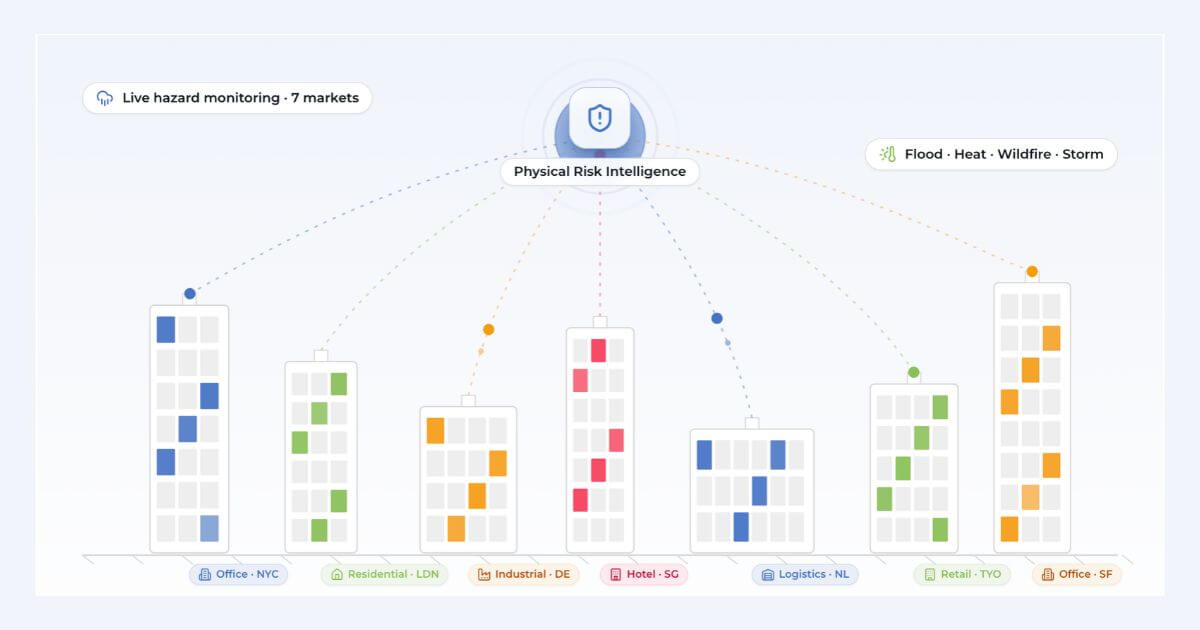
- Physical risk and surrounding-area resilience. Hazard data from 25 APIs are tied to each facility’s geo-coordinates and refreshed at runtime. A resilience view shows how hazards could affect the surrounding services, roads, and utilities of the asset.
- Insurability and insurance intelligence. Reads existing policy documents, flags lapsed cover and excluded risks, compares year over year, and files policies to the asset’s evidence record.
- Funding matched to the retrofit plan. Incentives, tax credits, green loans, and transition funding are matched to specific equipment upgrades, so users see net retrofit cost, not just gross investment. An Energy Optimization module ranks measures, from HVAC scheduling to solar and storage, by cash flow impact.
- Regulatory compliance. Global real estate-specific regulation monitoring to track benchmarking and carbon tax modeling deadlines, including NYC Local Law 97 and UK Minimum Energy Efficiency Standards (MEES), with an audit-ready evidence vault.
- Building monitoring. Tracks equipment lifecycle, energy performance, warranties, and servicing records.
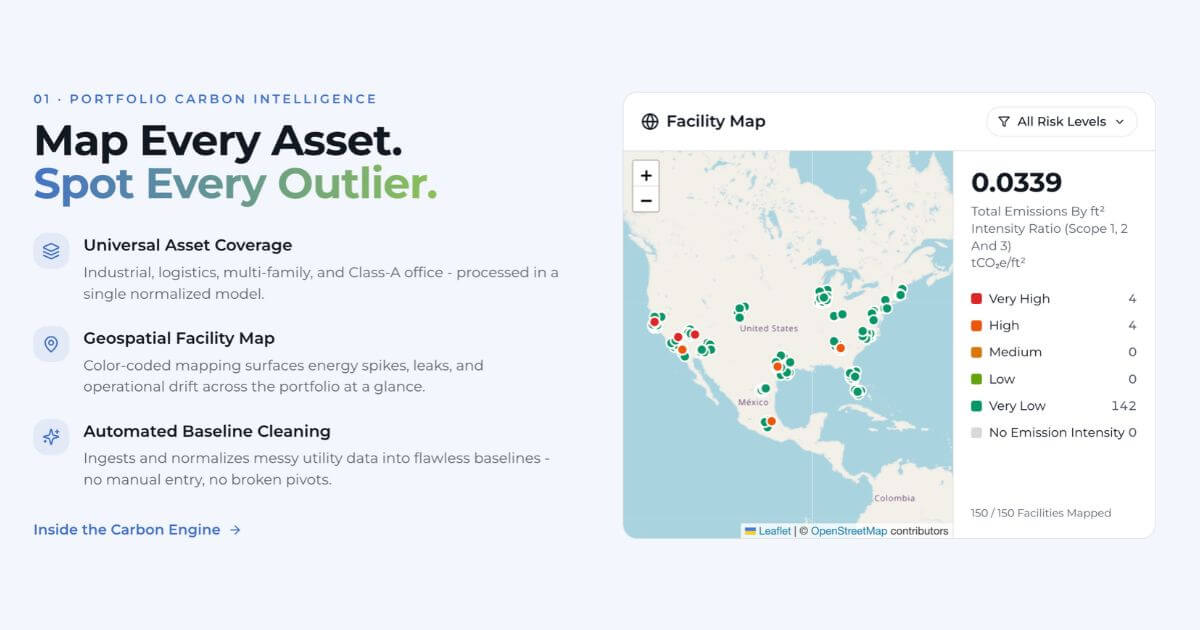
The dashboard connects to ESG Playbook’s carbon management tools, which support Scope 1, 2, and 3 reporting aligned with the GHG Protocol, TCFD, ISSB, and CSRD, alongside EU Taxonomy and SFDR alignment. For lenders, it also supports PCAF financed-emissions reporting.
“Real estate investors need to future-proof their portfolio for climate and transition risk with numbers they can defend,” said Sonia Zugel, CEO and Founder of ESG Playbook. “A deal team should be able to walk into an investment committee and say what the building will need, when it will need it, what funding can help pay for it, and where every figure came from.”
About ESG Playbook
ESG Playbook is an AI-enabled sustainability and risk management platform that helps organizations quantify climate, transition, and nature-related risks and turn them into defensible business decisions. Its offering spans three tiers: Essential Worksheets, Premium Modules, and the Enterprise Platform.
It was selected as a finalist in the 2026 Reuters Events Global Sustainability Awards for AI Excellence and SME of the Year Award, named to the ESGFinTech100 in 2024 and 2025, and recognized as a Major Contender in Everest Group’s Sustainability Enablement Technology PEAK Matrix. Learn more at esgplaybook.com.