
International Sustainability Standards Board
The International Sustainability Standards Board (ISSB) is an independent standard-setting body established by the IFRS Foundation to develop comprehensive global sustainability disclosure standards. It aims to provide investors and capital markets with consistent, comparable, and decision-useful information about companies’ sustainability-related risks and opportunities.
Key facts
- Founded: 2021
- Parent organization: IFRS Foundation
- Headquarters: Frankfurt, Germany (main); Montréal, Canada (co-location)
- First standards issued: IFRS S1 and IFRS S2 (2023)
- Chair: Emmanuel Faber
Formation and mandate
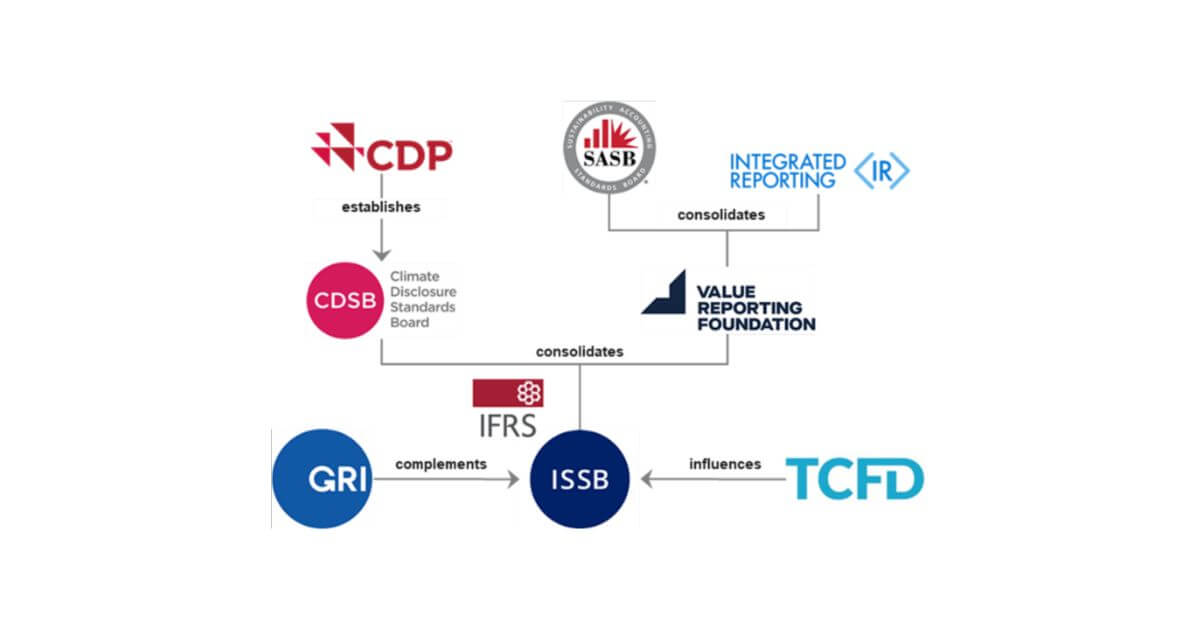
The ISSB was announced at COP26 in Glasgow in 2021, merging initiatives such as the Climate Disclosure Standards Board (CDSB) and the Value Reporting Foundation. Its mandate is to create a global baseline of sustainability-related disclosure standards, complementing financial reporting under the International Accounting Standards Board (IASB). The board’s work responds to fragmented sustainability reporting practices worldwide.
The ISSB builds on the work of market-led investor-focused reporting initiatives, including the Climate Disclosure Standards Board (CDSB), the Task Force for Climate-related Financial Disclosures (TCFD), the Value Reporting Foundation’s Integrated Reporting Framework and industry-based SASB Standards, as well as the World Economic Forum’s Stakeholder Capitalism Metrics.
The ISSB has international support with its work to develop sustainability disclosure standards backed by the G7, the G20, the International Organization of Securities Commissions (IOSCO), the Financial Stability Board, African Finance Ministers and Finance Ministers and Central Bank Governors from more than 40 jurisdictions.
ISSB key objectives
The ISSB has set out four key objectives:
- to develop standards for a global baseline of sustainability disclosures;
- to meet the information needs of investors;
- to enable companies to provide comprehensive sustainability information to global capital markets; and
- to facilitate interoperability with disclosures that are jurisdiction-specific and/or aimed at broader stakeholder groups.
ISSB Commitment
The ISSB is committed to delivering standards that are cost-effective, decision-useful and market informed.
- The standards are developed with efficiency in mind, helping companies to report what is needed globally to investors across markets globally.
- The standards are designed to provide the right information, in the right way, to support investor decision-making and facilitate international comparability to attract capital.
- A company can avoid double-reporting by applying the ISSB’s standards. When jurisdictional requirements build on the global baseline, companies are able to meet jurisdictional requirements while benefiting from the efficiency and comparability of the global baseline.
Standards and framework
In 2023, the ISSB issued IFRS S1 (General Requirements for Disclosure of Sustainability-related Financial Information) and IFRS S2 (Climate-related Disclosures). These standards integrate concepts from the Task Force on Climate-related Financial Disclosures (TCFD) and the Sustainability Accounting Standards Board (SASB). They are designed to align with existing financial reporting frameworks and can be adopted by jurisdictions worldwide.
Global impact and adoption
The ISSB’s standards are intended as a global baseline that regulators and companies can build upon. Several countries and stock exchanges have announced plans to align their sustainability disclosure requirements with IFRS S1 and S2. The initiative is expected to enhance transparency, comparability, and investor confidence in corporate sustainability reporting.
Governance and operations
The board operates under the IFRS Foundation’s governance structure, overseen by the Foundation’s Trustees and monitored by a Monitoring Board of public authorities. It collaborates with international standard-setters, regulators, and market participants through advisory bodies to ensure relevance and widespread acceptance of its standards.