
A new YouGov survey finds that 45% of Americans now expect to see catastrophic climate impacts within their lifetime. That’s not a distant scientific projection. It’s a mainstream expectation.
And it signals something deeper: climate risk has moved from abstract debate to personal timeline.
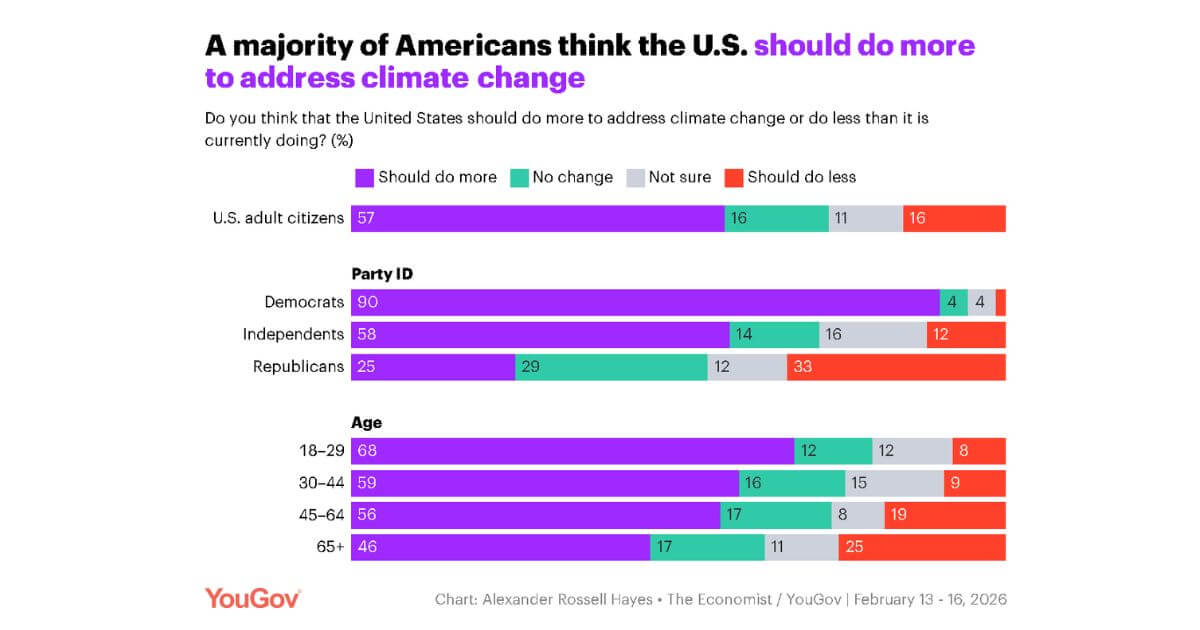
The climate perception gap is narrowing
What’s striking isn’t just the level of concern. It’s where it’s showing up.
According to the latest AEF survey, voters in states like Texas, Florida, Ohio, and Indiana are increasingly separating climate solutions from political identity. In these key states:
- 83% of voters view solar as strategically important for U.S. energy dominance
- 75% of Trump supporters agree solar is a strategic necessity
That’s not traditional environmental framing. That’s energy security, competitiveness, and economic resilience.
The political signal is changing.
Survivalism is the new sustainability
The shift isn’t ideological. It’s practical.
Americans aren’t just thinking about melting ice caps or polar bears. They’re thinking about:
- Their homes and insurance premiums
- Grid outages and extreme heat
- Local jobs and economic stability
Climate risk has become local and immediate. When nearly half the country expects disaster within their lifetime, it stops being a policy debate and starts becoming a household calculation.
This reframes sustainability from virtue signaling to self-preservation.
The solution consensus
There’s also a growing alignment on remedies, even among people who disagree on causes.
Clean energy is increasingly framed as:
- A national security imperative
- A competitive lever against China
- A way to stabilize or lower energy costs
- A path toward domestic manufacturing growth
When 83% of voters in politically mixed states support solar expansion, the conversation shifts from “Should we?” to “How fast?”
That’s a significant realignment of the sustainability landscape.
Perception creates market pressure
Public expectation shapes political and market behavior.
If 45% of Americans anticipate catastrophic climate events in their lifetimes, “business as usual” becomes more than a slow strategy. It becomes a reputational and fiduciary risk.
Companies operating in exposed regions face:
- Rising insurance costs
- Physical asset vulnerability
- Customer expectations for resilience
- Investor scrutiny around climate preparedness
Leadership teams that ignore this sentiment risk misreading both market demand and regulatory direction.
The widening leadership gap
Here’s the tension: public fear is accelerating. Institutional response often is not.
The gap between what voters expect and what systems deliver is widening. And in that gap lies political pressure, capital reallocation, and potential disruption.
Whether driven by environmental concern, energy independence, or economic competitiveness, the direction of travel looks increasingly similar:
- A more resilient grid
- Expanded domestic clean energy
- Reduced exposure to volatile fossil fuel markets
The framing may differ. The destination converges.
So the question now isn’t whether climate risk feels real to Americans.
It’s whether leadership, corporate and political, is moving at the speed of public expectation.